
Recent Elections in the U.S. and Germany Expose a Choice of Freedoms
Many are celebrating the "Blue Wave" that washed the shores of many legislative districts across the United States. The pundits proclaim: the American people have made themselves clear. But have they?


Dear fellow change-makers,
The 2026 U.S. elections yielded a sweeping transition of both houses of Congress, with Democrats taking control of both the House and the Senate. And not just by one or two seats. The margins are wide. Many are celebrating the "Blue Wave" that washed the shores of many legislative districts across the country. The pundits proclaim: the American people have made themselves clear.
But have they? In many parts of the country, support for the administration and its allies remains strong despite the corruption and unrest that has come to define the last two years. While the incoming chair of the House Oversight Committee has been making headlines with his message for current administration officials to "lawyer up", I cannot help but wonder what's going on in the deeps of America's collective consciousness. Could it be that the nation's mudslinging exposes an identity crisis in its founding concept of freedom? And what does the fight over freedom mean for the environmental, social, and economic crises threatening to drown global society?
Differing Concepts of Freedom
This reflection was inspired by an article about a leftwing party's (Die Linke or "The Left") victory in Berlin at a time when Germany seems to be leaning to the far right. In it, von Redecker writes that differing concepts of freedom undergird the country's increasingly polarized politics. She explains that freedom in countries that practice liberal capitalism (or neoliberalism) guarantees a freedom of possession. Historically, political contests between the left and right have been about who has the right to own and consume.
This assessment aligns with my research, personal observations, and experiences. In neoliberal societies and those that emulate them, progressives and conservatives alike govern using a framework based on property ownership and consumption. Profits, growth, GDP, and ROI become key navigational instruments. Individuals, corporations, and governments are granted rights through constitutions, charters, and governing authorities. Any rules, laws, people, species, and natural phenomena that interfere with property rights face legal challenge or censure. All are sorted into categories of deserving and undeserving, the haves and the have-nots. Those who are seen as undeserving, have-nots, or both are marginalized, then conceptualized as property to be mainstreamed, managed, or removed.
Die Linke promises to govern Berlin using a concept of freedom that enshrines the right to stay in the city. It challenges speculative housing markets and ownership rights, which have been prominent in progressive and conservative policy and planning agendas. Die Linke's promise implies that, instead of rights founded on property, identity, or credentials, being alive is enough to assert one's rights to housing. This fundamental idea also enshrines the right to have access to the means to take care of oneself and one's community and the right to have the environmental conditions to be healthy. It is a freedom to exist, in peace and harmony.
It's a radical concept in a neoliberal society. But it is not new.
This freedom lies at the root of the world's Indigenous practices and spiritual traditions. It is the foundation of human rights, which are inherent—not granted by any entity, government, or institution or dependent on position, wealth, or status. Political platforms promoting the end of capitalism are, at their core, a call for prioritizing the right for people, animals, and the natural environment to co-exist in harmony, unmolested, with thoughtful consideration in how each interacts with the other. Bringing the freedom to exist to mainstream politics touches on core needs of every being, regardless of political ideology, or even species. The freedom to exist is a call for a recalibration of our moral compass so that humanity and all things on this planet can thrive, together.
Reimagining Freedom in Practice
The freedom to exist promotes collective accountability and rejects the othering that must occur to uphold property rights for a select few in neoliberal societies. When everyone has a right to exist, everyone belongs and no one is illegal. Those facing hardship and vulnerabilities experience support through collective care. Policymaking and judicial decisions strive to find solutions and common ground rather than exploit differences, scapegoat groups, or maximize economic gains. Empathy and duty of care are essential practices, not concepts on paper. Die Linke's win in Germany, the housing crisis protests in Spain and South Africa, legal battles for Earth's intrinsic rights, youth protests across Asia, and other rights-centered movements seed the moral imaginings of the right to be at home in one's community, to keep your neighbors, to prioritize peace over possessions, and to be in harmonious relationships with other people and our environments. These inalienable rights transcend national boundaries and belong to all, no matter where we are, what we look like, what we believe, or what credentials we hold.
The pursuit of possession manufactures scarcity, and conflict is inevitable. Scarcity fuels fear and uncertainty, which show up in societies as poverty, racism, domestic violence, and other problems. Fear and uncertainty encourage hoarding and stockpiling resources to "win" and gain power and control for stability and security. When resources are (or seem to be) scarce, people strive for material wealth and ideological dominance over others, which can seed a sense of ownership of a place or control of another person's choices. No matter what a person possesses—a home, a city, a country, the planet—it will never be enough. There will always be an insatiable hunger to own, consume, and have more. The pursuers inevitably reach the limits of others to comply or the environment to supply, but ignore the feedback loops that signal when the limit has been reached.
The freedom to exist in harmony with others and one's environment fosters a different set of choices than the possession-driven logic that still dominates American politics. Other nations and international bodies are reimagining measures of progress and the pursuit of happiness. Will the "Blue Wave" bring greater freedoms that reinforce the right to exist in peace and harmony? I am curious to see which version of freedom will play out in the policymaking and judicial reasoning in the years ahead. And what it will do to the colors of the waves in elections to come.
What are your thoughts on freedom in the elections and politics where you live? Subscribers, log in and share your comments.
In gratitude,

Tracy Corley
Founder and President
Up Front
Here's what we're up to.
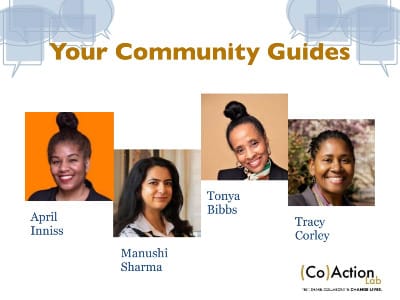
On October 13, I facilitated the first (Co)Action Lab Community Conversation. Sending deep gratitude to April Inniss, Manushi Sharma, and Tonya Bibbs for sharing their experiences as members of the current Practice Group.
(Co)Action Lab is a community of practice for change-makers who are co-creating a more caring world. Founded in 2018, the Lab brings together people from different movements and sectors into a virtual real-world laboratory to test ideas, exchange knowledge, and learn from others experiencing similar challenges.
I started the lab so that you don't have to do transformative work alone. Whether you're reimagining freedom, organizing for housing justice, or building collective care in your local community, the Lab offers a place to reflect and recharge alongside others who share your commitment to change.
But don't take my word for it: watch the video to hear what our members say.
Upstream
Here's what's coming in the months ahead.
A new world is taking shape at yuroboros. Our team has broken ground on a fresh online platform for (Co)Action Lab—a virtual real-world laboratory where community and institutional change-makers can co-create, ideate, and recharge together. Our 2027 Practice Groups will soon join current residents in our new home.
Want a peek? Details are under wraps for now, but a grand opening celebration is in the works. Be there when we cut the ribbon: subscribe to secure your invitation.
Uplifting
Here's what's inspiring and motivating us.
I originally wrote this month's newsletter to celebrate a Pulitzer Prize-winning poet whose love of nature inspires my own verses and social justice practice. But the election turned my attention to Dr. Jessica Hernandez, a fellow scholar, author, and advocate whose insights on indigenous science also keep me connected to nature's wisdom and transformative ways of studying the world.
More on poetry next month!
Meanwhile, what poems and stories are inspiring you? Subscribe and log in to comment.